


What Documents Should You Verify Before Buying a Property?
You should verify the documents that establish ownership, show the property's transaction history and confirm its municipal and construction records. The exact documents depend on whether you are buying a site, apartment, independent house or agricultural land.
Sale Deed or Title Deed: Start with the registered document that shows how the current owner acquired the property. Check the owner's name, property description, survey number, boundaries, extent and registration details.
Mother Deed and Previous Title Documents: These documents help establish how ownership moved from earlier owners to the present owner. Do not check only the seller's latest sale deed if older title documents are available.
Encumbrance Certificate: Check the EC for registered transactions and encumbrances recorded against the property for the period requested. An EC should be compared with the property's known registration history rather than treated as the only title check.
Khata and Property Tax Records: For Bengaluru properties, the current e-Aasthi system provides property-related records and allows citizens to search property information. The official e-Aasthi portal also lists title deed, Khata records and the current assessment-year tax-paid receipt among documents used for property records.
Building Approval and Occupancy Certificate: For applicable buildings in Bengaluru, check whether the sanctioned building plan and occupancy records correspond with the property. BBMP's Town Planning records provide facilities for checking plan sanction, commencement certificate and occupancy certificate information.
The Greater Bengaluru Authority currently lists e-Aasthi, Property Tax and Building Permission among its online services.
How to Verify Property Documents Step by Step?
The safest approach is to compare the seller's documents with government records and the property at the site. Do not rely on a single certificate.
Step 1: Collect the Original Property Documents
Ask the seller to provide the original sale deed and available parent or previous title documents. Also collect the EC, e-Khata documents, recent property-tax receipts and applicable building approval documents
The official e-Aasthi system lists documents such as a title deed, Khata certificate or extract and the current assessment-year tax-paid receipt for e-Aasthi applications. This gives you a useful starting checklist for a Bengaluru property.
Do not begin verification with only a photocopy of the latest sale deed. Ask for the documents that explain how the property reached the current owner.
Step 2: Check the Current Owner's Name
Compare the seller's name across the sale deed, Khata record, tax record and other available property records.
Check the spelling carefully. Also compare the owner's address and other identifying details wherever they appear.
If the seller is acting through a Power of Attorney, legal heirs, a company or another authorised person, ask for the document that establishes their authority to deal with the property.
Step 3: Verify the Previous Title Documents
Read the previous sale deeds, gift deeds, partition deeds, release deeds or other documents that form the property's ownership history.
The property description should remain consistent as ownership changes. Compare the survey number, site or flat number, extent, boundaries and location across the documents.
For land-related records, Karnataka government documentation itself refers to the importance of the RTC, registered ownership document, mutation record and EC when establishing land details for official applications.
If there is a gap in the ownership history, do not assume that the latest sale deed automatically resolves it. Ask for the missing document and have the title chain examined.
Need help with how to verify property documents? Talk to Vault and Get Property Due Diligence done today.
Step 4: Check the Encumbrance Certificate
The Encumbrance Certificate (EC) should be checked against the property's registration history for the period covered by the certificate. Compare the transactions shown in the EC with the sale deed and previous title documents.
For older properties, don't assume that an online EC search covers the entire ownership history. Kaveri's digitised registration records begin from 1 April 2004. Transactions before this date may require a manual search through the concerned Sub-Registrar Office.
This matters if the property has been owned for more than two decades. For example, if a property was transferred in 1998 and changed hands again in 2010, checking only the digitised records may not establish the complete earlier transaction history.
If the ownership chain goes back before 1 April 2004, ask for the older registered documents and arrange a manual search at the relevant Sub-Registrar Office. The EC should be used alongside the sale deed and previous title documents, not as the only title check.
Step 5: Verify Khata and Property Tax Records
For Bengaluru properties, check the property in the official e-Aasthi system and compare the available property information with the seller's documents.
The e-Aasthi portal allows property searches and provides options related to e Khata, property ownership searches and property information. Its current instructions also state that a draft e Khata is based on the existing BBMP Property Tax Register.
Check the property number, owner's name, assessment information and tax records against the documents provided by the seller.
If the tax record and title documents contain different property details, resolve the difference before proceeding.
Step 6: Match the Property With Government Records
The details on paper should match the government records and the actual property.
Compare:
Survey number
Site or flat number
Property identification number, where applicable
Total area
Boundaries
Owner's name
Location
Khata details
Building details, where applicable
For Bengaluru properties, the official e-Aasthi system provides search options for property records, including searches by owner name and other property information.
A document showing one area while the actual property or another government record shows a different area needs further examination.
If you need to verify land ownership and revenue details, you check Bhoomi RTC record online through Vault Instant service. Get Instant Bhoomi RTC.
Step 7: Inspect the Property Against the Documents
Visit the property and compare its physical details with the documents.
For a site, check the boundaries, survey number and dimensions. For an apartment, compare the flat number, floor, built-up area and other identifying details with the sale documents.
For buildings in Bengaluru, BBMP's Town Planning records include plan sanction and occupancy certificate information. BBMP's occupancy certificate procedure also includes verification of the as-built structure against the sanctioned drawing.
If the actual construction differs materially from the approved plan, ask for the relevant approval or clarification before proceeding.
Step 8: Get Professional Title Verification
A property document check should not end with an online search. A qualified property lawyer or due-diligence professional should examine the title documents, ownership chain and available government records before a major property purchase.
The professional review should identify missing documents, inconsistencies in the ownership history and issues that require clarification.
For a high-value purchase, complete this verification before signing the final sale agreement or paying a substantial advance.
How Can You Verify Property Documents Online in Karnataka?
You can verify several property details online in Karnataka, but online verification should be treated as one part of the document-checking process. Government portals can help you compare registration, land and municipal property information.
Kaveri Online Services
Karnataka's Registration and Stamps Department uses the Kaveri i.e, https://kaveri.karnataka.gov.in/landing-page for registration-related services. The department's annual report records the rollout of Kaveri 2.0 across Sub-Registrar Offices.
Use the registration information available through the system to cross-check details such as registered documents and property transactions, wherever the relevant search facility is available.
Bhoomi and Land Records
For properties involving agricultural or revenue land records, check the relevant RTC and mutation information through Karnataka's land-record portal i.e, https://landrecords.karnataka.gov.in/Service2/.
Compare the survey number, extent and ownership-related information with the documents given by the seller.
A mismatch between the registered deed and revenue records should be investigated rather than ignored.
e-Aasthi for Bengaluru Properties
For properties within Bengaluru's municipal property-record system, e-Aasthi Portal i.e, https://bbmpeaasthi.karnataka.gov.in/ provides property search and eKhata-related services.
The current e-Aasthi portal provides options to search properties, search properties by owner's name and access eKhata-related information. It also states that additional documents may be required for final eKhata, including a registered deed and, where applicable, an EC when an immediate sale or transfer is planned.
Check Records when you need help comparing property records before purchase.
Building Permission and Occupancy Records
For applicable Bengaluru buildings, BBMP's Town Planning system provides records relating to plan sanction, commencement certificates and occupancy certificates.
BBMP's published occupancy certificate procedure includes verification of the as-built structure against the sanctioned drawing. This makes the approved plan and occupancy records useful documents to compare with the building that actually exists.
Online records are useful for cross-checking. They should not replace examination of the original registered documents.
What Problems Should You Check While Verifying Property Documents?
The main problems to check are differences in ownership details, missing previous documents, inconsistent property measurements, survey-number differences and gaps between government records and the documents supplied by the seller.
Owner's name does not match: If the seller's name differs across the sale deed, Khata or property records, ask for the reason and supporting document.
Previous documents are missing: If the current sale deed refers to an earlier transaction but the previous document is unavailable, obtain the missing document before relying on the ownership history.
Survey number or property number differs: A difference in the survey number, site number, flat number or property identification number needs to be checked against the relevant government record.
Area or boundaries differ: Compare the area and boundaries mentioned in the sale deed with the property and other records. Do not assume that a small difference is harmless without checking the reason.
EC does not match the known history: If a registered transaction known to have taken place is not reflected as expected in the EC, ask for clarification and obtain the appropriate records.
Tax records show different details: Compare the property-tax record with the title documents. A mismatch in the owner's name or property identification details should be resolved.
Construction differs from approved records: Compare the actual building with the sanctioned plan and applicable occupancy records. BBMP's Town Planning system specifically maintains plan sanction and occupancy certificate information.
Khata information is different: Compare the Khata/eKhata details with the registered deed and property-tax information. A Khata record by itself should not be treated as proof of clear title.
If any of these differences remain unexplained, pause the purchase process until the relevant document or clarification has been obtained.
How Vault Helps with How to Verify Property Documents
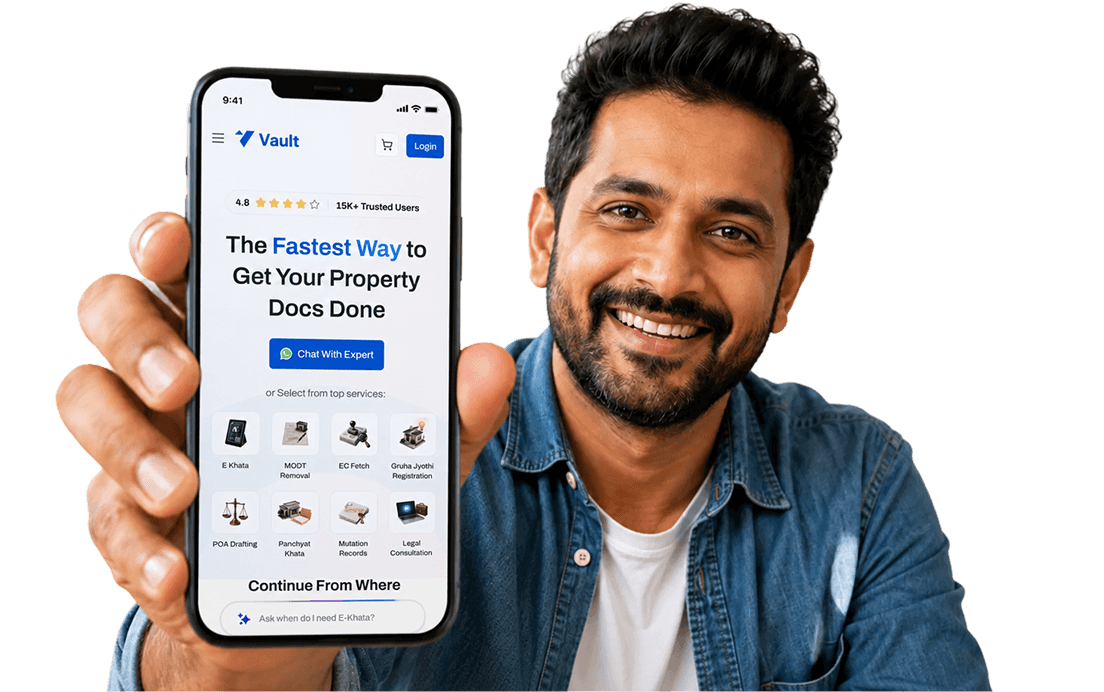
Vault Proptech helps property buyers review documents and property records through its property due diligence service in Bangalore. The process can be used to examine the available ownership and property documents before you proceed with the purchase.
The review can help you organise the documents, compare important property details and identify discrepancies that need further clarification. This is particularly useful when the property has several previous owners or a large set of supporting documents.
For buyers who are not based in Bangalore, professional document review can also make the verification process easier to manage without personally visiting every office for an initial review.
Looking for professional help with how to verify property documents? Get Due Diligence Assistance.