Is a Non-Binding Agreement Legally Valid in Bangalore India?

Learn what a non-binding agreement means in Bangalore real estate. Understand how letters of intent and MoUs work under Karnataka laws before signing in 2026.
Quick Summary: (TL; DR)
A non-binding agreement in Bangalore, like an MoU or LOI, holds no legal validity for forcing a property sale. While basic terms remain optional, specific clauses like confidentiality, exclusivity, or booking fee refunds are fully enforceable. Always verify property titles and BBMP approvals before transferring any token advance to prevent long-term financial traps.
What Is a Non-Binding Agreement in Bangalore Real Estate?
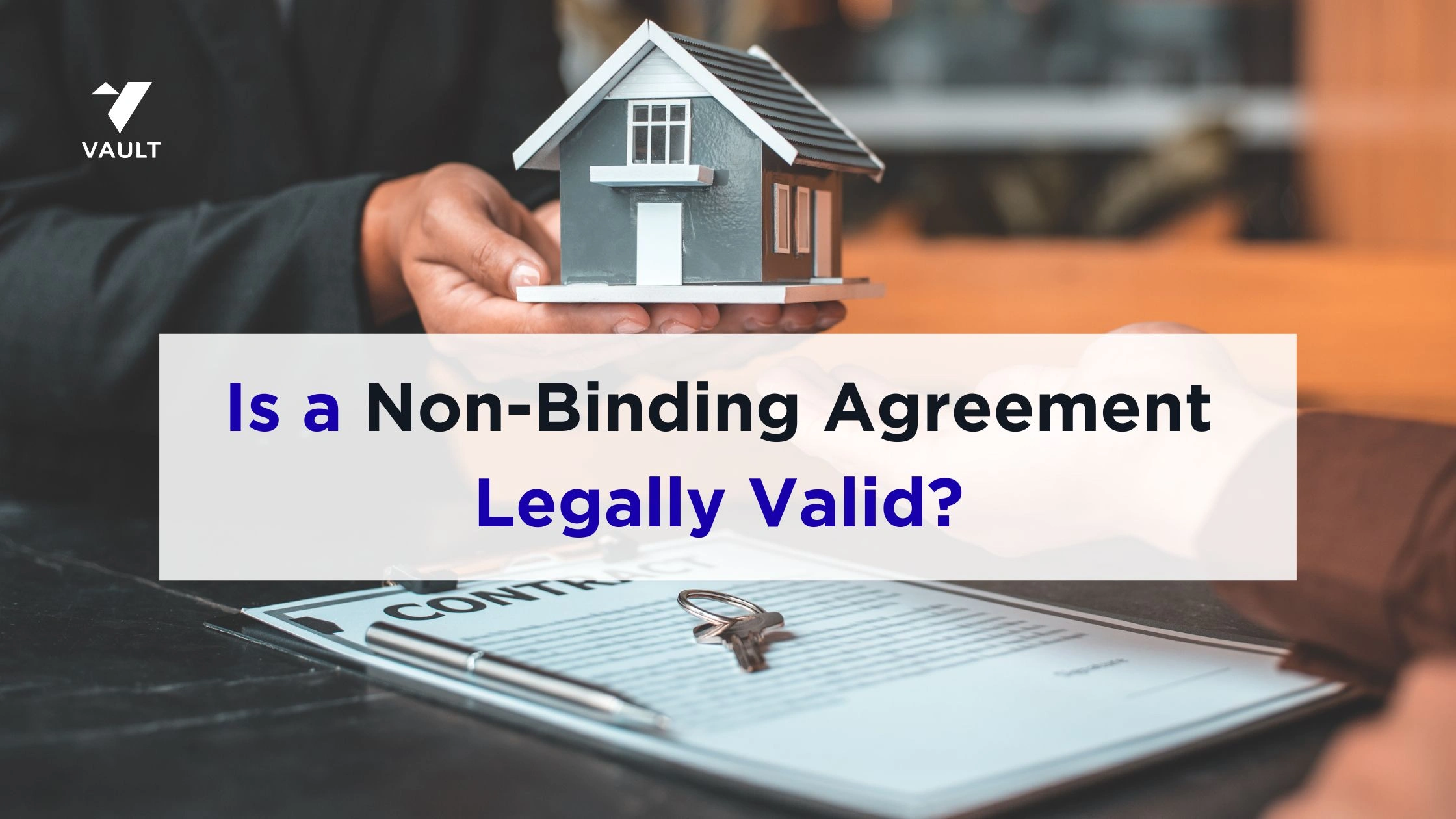
A non-binding agreement in Bangalore real estate is a preliminary document expressing interest in a property transaction without legally forcing either party to complete the final sale.
Think of it as a formal handshake on paper that allows both parties to set ground rules while they perform their background checks.
If you have spent even a single weekend searching for a home in Bangalore, you already know how fast the market moves. From sprawling high-rises in Sarjapur and Whitefield to trendy gated communities in Devanahalli, properties sell out in days.
Because of this intense competition, buyers often feel pressured to “lock in” a flat while their lawyers run a fine-tooth comb through the paperwork.
This is where a non-binding agreement usually drafted as a Memorandum of Understanding (MoU) or a Letter of Intent (LOI) comes into play.
These preliminary documents put the basic commercial understandings on record. They outline what you expect to pay, the super built-up area of the apartment, the payment timelines, and the specific unit allocated to you.
Developers love using these during pre-launch phases, especially when they are still waiting for building plan sanctions from the Bangalore Bruhat Mahanagara Palike (BBMP) or the Bangalore Development Authority (BDA).
By signing a non-binding MoU, you show the builder that you are a serious buyer without committing your life savings upfront. For the developer, it serves as an administrative tool to gauge market interest before they open up final registrations on the state’s Kaveri 2.0 portal.
Is a Letter of Intent or MoU Legally Binding in Karnataka?
There is one very serious problem every Bangalore buyer misses: even though the entire transaction within the MoU can be non-binding, there can be specific parts of the same MoU document that are very much binding. For instance, imagine a ‘confidentiality’ clause (you agree not to share the details of your potential sale to anyone) or an ‘exclusivity clause’ (you get exclusivity for a month or so to buy this property from him).
You could still potentially sue the Bangalore seller for damages if he sold the flat to someone else within this time frame. While you can’t be forced to buy the property from him at the MoU price, he’d still have to answer to a Bangalore civil court for the breach of trust.
To see how this works under local law, we have to look at Section 10 of the Indian Contract Act, 1872. For any agreement to have legal teeth, there must be free consent, lawful consideration, a lawful object, and a clear, mutual intention to create legal relations.
If your MoU states that a final “Agreement to Sell” or “Sale Deed” will be executed in the future, the document remains completely non-binding regarding the actual purchase of the property. Either party can walk away from the deal.
There’s one major hitch that catches most Bangalore buyers by surprise: while the entire property sale in the MoU may be non-binding, there may be specific clauses within that very same document that are completely binding.
Take the case of a “confidentiality clause” (a pledge not to discuss terms of sale with others) and an “exclusivity clause” (an agreement not to sell the apartment to another party for 30 days).
The seller can absolutely be held liable for damages if he sells the apartment to someone else within the 30-day window you have exclusive rights for.
While he may not be compelled to sell the property to you at the agreed price, he certainly can be taken to a Bangalore civil court for breach of trust.
Need Help with Property Documents? Talk to Vault Lawyer and get legal Guidance.
What Are the Key Differences Between Binding and Non-Binding Agreements?
The single biggest difference is that a binding contract allows you to drag the defaulting party to court to force them to complete the sale, while a non-binding agreement does not. In Karnataka, creating a binding contract also requires strict administrative compliance, including mandatory e-stamping and physical registration at the Sub-Registrar’s Office (SRO).
A simple step-by-step comparison of how the two property types will stack up:
Property Type | Legal Binding | Stamp Duty Costs | Registration Fees | Token Money Refund |
|---|---|---|---|---|
Non-binding MOU / LOI | Cannot compel transfer | ₹100–200 e-stamp | Not Applicable | Yes, fully refundable |
Registered Agreement to Sell | Yes, enforceable in court | 5% of Guidance Value + Cess + Surcharge | 2% of property value (Kaveri 2.0) | Forfeitable if buyer defaults without reason |
This clear division is why the timing of these documents matters so much. Signing a fully binding Agreement to Sell in Bangalore is a serious, expensive process. Since the Karnataka government doubled the property registration fee from 1% to 2% (effective from late 2025), registering a binding agreement on the Kaveri 2.0 portal requires paying substantial upfront fees alongside the standard slab-based stamp duty (which is 5% for properties valued above ₹45 lakh).
A non-binding MoU keeps you out of the Sub-Registrar’s Office while your legal team performs essential background checks, saving you from locking up major capital in stamp papers too early.
Can You Refund Token Money Paid Under a Non-Binding MoU in Bangalore?
Yes, token money paid under a non-binding MoU is fully refundable in Bangalore if the deal falls through, unless the agreement explicitly contains a specific clause allowing the seller to forfeit the deposit. If your lawyer finds a title defect or an unapproved layout plan, the seller has no legal right to keep your money.
Paying a “booking advance” or “token money” is a standard ritual in Bangalore’s real estate market. Buyers hand over anywhere from ₹50,000 to a few lakhs to show they are acting in good faith. If you have only signed a non-binding MoU and later decide to back out because the property lacks proper civic approvals, the seller is legally obligated to return every single rupee. Because the MoU is not a concluded contract of sale, keeping your token money would constitute “unjust enrichment” under the law.
However, do not rely on verbal promises from developers or brokers. Clearly state in the MoU that the token amount is completely refundable (within 7–10 working days of the advocate’s due diligence process) if your advocates find that there is any legal risk, gaps in title, or any missing BBMP sanction. In case your builder does not return the deposit amount on this account, you may choose to submit a complaint with the K-RERA or pursue a summary suit for recovery from civil courts.
Why Is Property Document Verification Crucial Before Signing MoUs?
Property document verification is crucial because it is your only shield against buying into a legal dispute, an unauthorized construction, or a property with massive outstanding debts. Doing your homework early prevents your booking advance from getting trapped in years of messy court battles
Many home buyers in Bangalore make the mistake of handing over token money based purely on glossy marketing brochures and fancy model flats. They assume that since the MoU is non-binding, their money is perfectly safe. But the reality is that chasing a defaulting builder or an individual seller to get a refund is an exhausting, stressful process. It is always better to check the papers before you write the check.
Your legal check must include downloading a 30-year Encumbrance Certificate (EC) from the Kaveri 2.0 portal to confirm there are no active bank mortgages or pending litigations on the property. Check the mother deed, BBMP Khata (should be A-Khata only never buy B-Khata properties), and get to see the sanctioned plan for the building.
If you are buying a plot or villa outside of Bangalore, you must confirm whether the project is approved by BDA, BMRDA, or BIAAPA. Projects that are not approved often will not get a water connection from BWSSB and will become a risky asset.
Need Help with Property Documents? Talk to Vault Lawyer and get legal Guidance.
How Can You Keep a Bangalore Property Agreement Safely Non-Binding?
You can keep an agreement safely non-binding by inserting a clear, unambiguous “intent clause” stating that the document does not create any legal relationships and is strictly subject to the execution of a registered sale agreement. You must also avoid using absolute, contract-style language that could lead a judge to rule that a binding deal had already begun.
The drafting needs to be incredibly precise. Avoid using definitive phrases like “the purchaser agrees to buy” or “the seller shall sell.” Instead, use conditional language such as “the parties intend to negotiate” or “the transaction is subject to a satisfactory legal title report.”
The most critical element is a dedicated “Non-Binding Clause” positioned clearly in the document. This section should read: “Except for the clauses on exclusivity, confidentiality, and dispute resolution, this Memorandum of Understanding does not create any legal rights, liabilities, or obligations on either party, and neither party can seek specific performance of this transaction in any court of law.”
Additionally, never let the MoU refer to your token advance as a “part-payment of the sale price,” as this single phrase can be used by a seller to argue in court that you have already initiated a binding transaction.
Vault Expert Insight
“Most property disputes in Bangalore arise when buyers sign vague pre-launch MoUs without completing proper title checks. Always draft a clear non-binding clause and never release substantial funds before verifying the mother deed and RERA status.” - Krishna LLB, Advocate, Bangalore
How Does Vault Help with Property Documentation in Bangalore?
Sorting through preliminary agreements, local land records, and municipal approvals in Karnataka requires specialized local expertise. Vault provides complete, end-to-end property document verification and legal assistance for home buyers in Bangalore. Whether you need a property lawyer to review a non-binding MoU, download a 30-year Encumbrance Certificate, or draft a legally sound registered Sale Deed on Kaveri 2.0, Vault’s experienced legal team ensures your transaction is completely secure. Avoid expensive legal traps and check your property documents today with Vault to secure a smooth, legally compliant transaction in Karnataka.
Need Help with Property Documents? Talk to Vault Lawyer and get legal Guidance.