How to get Podi Pauti? Land Survey Division Karnataka 2026 Guide

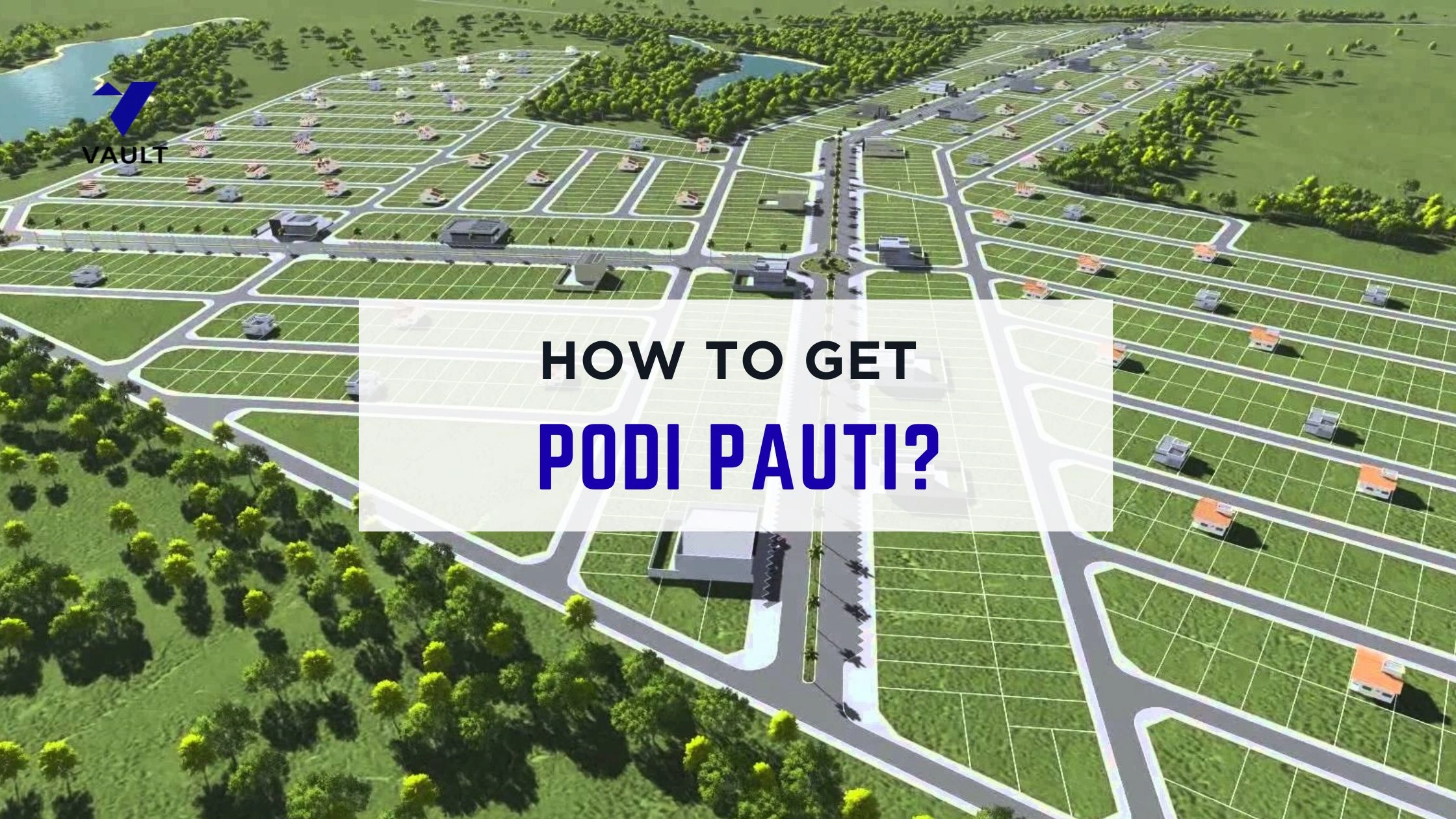
What is Podi Pauti in Karnataka? Complete guide to Podi meaning, Pahani, Hissa, types of Podi, Tatkal Podi, how to apply, process, and its role in land registration and property transactions.
Quick Summary (TL; DR)
Podi (ಪೋಡಿ) is the official subdivision of a survey number into smaller parts. It is done by the Survey Department. After Podi, each sub-division gets its own hissa number in the Pahani (RTC).
Pauti is the updated payment record, the column in the land register that records the revenue/assessment dues after a subdivision or change of ownership.
Together, 'Podi Pauti' refers to the process of subdividing land AND updating the corresponding revenue payment records in Karnataka's Bhoomi system.
Podi is mandatory in Karnataka before selling a part of a larger agricultural survey number. You cannot register the sale of a portion of land at the Sub-Registrar's office without a completed Podi sketch (Form 11E).
Two types: Regular Podi (free, takes 3-12 months) and Tatkal Podi (paid, Rs 5,000-15,000, completes in 30 to 60 days).
You are buying 2 acres out of a 10-acre agricultural plot in Karnataka. The survey number on the RTC shows the entire 10 acres with multiple co-owners. You want to register just the 2 acres in your name.
The Sub-Registrar tells you: you cannot register this transaction without a Podi sketch. The survey number must first be subdivided. Your specific 2 acres must get their own hissa number.
Podi is the legal process that makes a portion of land identifiable and registerable. Without it, no bank will fund the purchase, no Sub-Registrar will register it, and no one knows exactly which piece of ground you own.
This guide explains what Podi and Pauti mean, how they relate to Pahani and hissa, the different types of Podi, the step-by-step application process, and why it matters for every agricultural land transaction in Karnataka.
What Is Podi? Meaning Explained
Podi (ಪೋಡಿ) in Karnataka land records means the official sub-division of a survey number into two or more separate sub-divisions. Each sub-division after Podi is assigned a new hissa number in the Pahani (RTC , Record of Rights, Tenancy and Crops).
The word Podi comes from Kannada and literally means ‘to divide’ or ‘piece’. In the context of land records, it specifically refers to the formal, legally recognised process by which the Survey and Settlement Department of Karnataka physically surveys, measures, and subdivides a larger survey number into smaller, individually identifiable portions.
PODI: SIMPLE DEFINITION
Podi = Official sub-division of an agricultural survey number into smaller hissas
Done by: Survey Department (ADLR, Assistant Director of Land Records) officials
Result: Original survey number (e.g., Sy. No. 45) becomes Sy. No. 45/1 and Sy. No. 45/2
Recorded in: Bhoomi RTC (Pahani) on landrecords.karnataka.gov.in
Mandatory for: Selling, gifting, or registering a portion of a larger survey number
Without Podi: The Sub-Registrar cannot register a partial sale of a larger survey number
What Is Pauti? Meaning Explained
Pauti (ಪೌತಿ) in Karnataka land records refers to the assessment/revenue record , specifically the updated column in the land register that records the land revenue assessment and payment obligations for a survey number or sub-division.
After a Podi is done and a new hissa is created, the revenue assessment for that specific sub-divided portion must be recalculated and recorded. This updated record of the assessment and dues is called Pauti. It links the new hissa number to its specific revenue obligations in the government’s accounts.
In practical usage: When people say ‘Podi Pauti’ together, they typically mean the complete process of land subdivision (Podi) along with the corresponding update to the revenue payment records (Pauti). Both are part of the same administrative chain that follows when agricultural land is divided.
Alternate spelling: Podi Pahani, Phodi, Phodi Pauti, all refer to the same concept. Pahani is also used to mean the RTC itself. See the difference between Podi and Pahani below.
Understanding the Relationship: Podi, Pahani, Hissa, and RTC
These four terms are closely related but mean different things. Understanding how they connect is essential for reading any agricultural land document in Karnataka.
Term | Kannada | What It Means | Where You See It |
Pahani / RTC | ಪಹಣಿ / ಭಾವಪತ್ರ | Record of Rights, Tenancy and Crops , the 13-column legal document that is the master record for any piece of agricultural land in Karnataka | Bhoomi portal (landrecords.karnataka.gov.in) |
Survey Number | ಸರ್ವೇ ನಂಬರ್ | The unique number assigned to a land parcel during the original survey of a village. Can be one large undivided area owned by one or many. | Pahani, sale deed, Encumbrance Certificate |
Hissa | ಹಿಸ್ಸಾ | A sub-division of a survey number. After Podi, each divided piece gets a hissa number. Format: Survey No. 45 becomes 45/1 and 45/2. | Pahani after Podi is done |
Podi | ಪೋಡಿ | The formal process of dividing a survey number into hissas. Involves physical measurement by the Survey Dept and updating the Pahani. | Podi application, Bhoomi mutation after Podi |
Pauti | ಪೌತಿ | Updated revenue assessment record after subdivision or ownership change. Part of the revenue accounting for each hissa. | Revenue registers, Pahani Column 4 (assessment) |
Mutation / MR | ಮೂಟೇಶನ್ | Updating the Pahani to reflect the new owner’s name after a sale, gift, or inheritance | Bhoomi mutation register |
Simple chain: You own Survey No. 45 (entire 10 acres). You do Podi → it becomes Sy. 45/1 (your 2 acres, specifically surveyed and mapped) and Sy. 45/2 (remaining 8 acres). Sy. 45/1 gets its own Pahani entry with its own Pauti (revenue assessment). You can now register the sale of Sy. 45/1 at the Sub-Registrar’s office.
Why Is Podi Mandatory in Karnataka?
Karnataka made Podi mandatory for partial land sales as part of digitising land records. The key rule: a sub-division sketch (Form 11E) showing the proposed split must be submitted before the Sub-Registrar will register any partial sale of an agricultural survey number.
Situations Where Podi Is Required
Selling a portion of your agricultural land, you cannot sell half a survey number without Podi
Dividing land between family members (partition among legal heirs or siblings)
Gifting a specific portion of land to a child or relative
Converting a portion of agricultural land for non-agricultural use (before DC conversion)
Getting a bank loan against a specific identified portion of a larger survey number , banks require a clear hissa
Clearing a joint RTC, when multiple co-owners exist on a single survey number and one wants to hold a clearly identified individual portion
Consequences of Not Doing Podi
Sub-Registrar will refuse to register the sale deed for a partial survey number
Banks will not approve a loan against an undivided share in a larger survey number
Co-owners cannot sell their portion independently without risking disputes
Mutation of the new owner’s name in the RTC is not possible for an undivided portion
The sold portion cannot be identified on the ground, and boundary disputes become inevitable
WITHOUT PODI: When a co-owner sells their undivided interest in a property, the purchaser's name cannot be entered in land records until the property is partitioned through Podi.
This means the buyer may have a registered sale deed, but their name will NOT appear in the Pahani/RTC.
Karnataka Revenue Department guidelines confirm: purchasers of undivided shares must seek legal partition (Podi) before the sale can be fully recorded in government land registers.
Always insist on a completed Podi before purchasing a partial survey number or undivided share of agricultural land.
Types of Podi in Karnataka
Type of Podi | What It Is | Who Applies | Timeline | Fee |
Regular Podi (Samanya Podi) | Standard Podi application processed in the normal queue of the Survey Department | Any landowner wanting to divide their survey number | 3 to 12 months (sometimes up to 24 months in backlogged districts) | Free of charge |
Tatkal Podi | Fast-track paid Podi scheme for urgent cases. Priority processing by the Survey Department | Any landowner who needs Podi completed quickly for a sale or registration | 30 to 60 days from survey appointment | Rs 5,000 to Rs 15,000 depending on district and number of sub-divisions (as of 2026) |
Dharkasth Podi | Podi for government-granted land (Dharkasth land). Required before any sale, gift, or DC conversion of grant land Holders of Dharkasth (government-granted) land | Longer timeline , passes through Village Secretary, Tahsildar, Assistant Commissioner, Deputy Commissioner | Varies , consult Tahsildar | |
Pyki (Piki) Sub-division | An undivided fractional share within a survey number, shown as ‘Pyki’ in the RTC. NOT the same as completed Podi. Indicates an undefined share. | Historical entry , no formal application. Arises from inheritance and old records. | Not a process , it is an existing record status | N/A |
Hissa Survey (Podi Andolan) | Government drive to correct RTC errors, convert joint RTCs to individual ownership, update inheritance records. Done at farmers’ doorstep. | Farmers with multiple owners in RTC, grant land records, inheritance updates | Ongoing government initiative , free | Free under Podi Mukta Abhiyaan |
Tatkal Podi: The most practical option for buyers and sellers who need Podi completed before a registration deadline. In most Bengaluru rural districts, the regular Podi queue runs 12 to 18 months. Tatkal Podi at Rs 5,000 to Rs 15,000 is almost always worth it when a property sale is at stake.
How to Apply for Podi in Karnataka: Step-by-Step
Step 1: Verify the RTC on Bhoomi Portal
Before applying for Podi, download the current RTC from landrecords.karnataka.gov.in. Confirm:
Your name appears as Khatedar (landowner) in Column 9
The survey number and extent you want to subdivide is correct
There are no court stays, attachments, or government acquisition notices in Column 11
The current mutation is complete and reflects you as the owner
Step 2: Prepare a Proposed Sub-Division Sketch (Form 11E)
Form 11E is the proposed subdivision sketch showing how the survey number will be divided. It must show:
The existing survey number with the total extent
The proposed boundaries of each new subdivision
The proposed extent of each hissa in acres and guntas
A sketch/map showing the layout of the subdivision
This sketch can be prepared by a licensed surveyor or by the Survey Department itself during the Tatkal Podi process. For regular Podi, the department’s own surveyors will prepare it after your application.
Step 3: Submit Application at the Tahsildar’s Office
Submit the Podi application at the Tahsildar’s office for the relevant taluk. Required documents:
Application letter requesting Podi with reason (sale, partition, gift, etc.)
Pahani / RTC copy (downloaded from Bhoomi portal)
Original registered sale deed or partition deed (if applicable)
Aadhaar card of the applicant
Proposed sub-division sketch (Form 11E) if self-prepared
Encumbrance Certificate for the survey number
Consent of all co-owners (if the survey number has multiple owners)
For Tatkal Podi: Submit the same documents plus the Tatkal Podi fee payment at the Tahsildar’s office. Confirm current fee at your district’s Tahsildar’s office.
Step 4: Field Survey by ADLR Officials
After application, officials from the Survey Department (ADLR , Assistant Director of Land Records, along with a surveyor) will visit the land to:
Physically measure the land
Mark the boundaries of each proposed hissa
Verify the extent matches the Pahani records
Prepare the official sub-division sketch
The landowner must be present during the field survey. Presence of adjacent landowners is also helpful to confirm boundaries.
Step 5: Tahsildar Assigns New Hissa Numbers
After the field survey and report is submitted by the ADLR, the Tahsildar passes an order assigning new hissa numbers to each sub-division. For example:
Before Podi: Survey No. 45 , 10 acres, owned by A
After Podi: Survey No. 45/1 , 2 acres, portion to be sold | Survey No. 45/2 , 8 acres, remaining with A
Step 6: Pahani (RTC) Is Updated on Bhoomi Portal
After the Tahsildar’s order, the Bhoomi database is updated. The original survey number entry is updated to show the two new hissas with their respective extents, owners, and assessment details. Check the updated RTC on landrecords.karnataka.gov.in.
Step 7: Proceed With Registration / Mutation
Once the Podi is completed and the new hissa numbers appear in the Pahani, the property can be registered at the Sub-Registrar’s office (for a sale) or mutation can be applied for (for inheritance, gift, etc.). The sale deed will reference the new hissa number, not just the original survey number.
What Is Pahani? The Land Record Behind Podi
Since Podi and Pahani are inseparable, understanding Pahani helps complete the picture.
Pahani (RTC , Record of Rights, Tenancy and Crops) is the primary land record document for agricultural land in Karnataka. It is a 13-column document maintained by the Revenue Department and accessible on the Bhoomi portal at landrecords.karnataka.gov.in.
Column and What It Records
Column 1 to 3: Survey number, hissa number, and total area of the land
Column 4: Revenue/assessment details (Pauti, the tax due on the land)
Column 5: Nature and classification of the land (agricultural, dry, wet, etc.)
Column 6: Owner of the patta, whether government (Sarkar) or private
Column 7: Water rate assessment
Column 8: Soil type and irrigation source
Column 9: Owner’s name, extent of share, and Khata number, the most critical column
Column 10: Mutation history, year, and reason for each name change
Column 11: Encumbrances, bank loans, mortgages, court stays, attachments
Column 12: Tenancy details (if the land is under a tenant)
Column 13: Crop details, crops grown, area under each crop, irrigation method
How to download Pahani on Bhoomi portal: Visit landrecords.karnataka.gov.in → View RTC and MR → Select District, Taluk, Hobli, Village → Enter Survey Number and Hissa → Fetch Details. For a legally valid digitally signed copy (i-RTC), use the i-RTC Wallet service, fee approximately Rs 10-15. An i-RTC is valid in courts, banks, and government offices.
Digital Portals Related to Podi and Pahani in Karnataka
Tool / Portal | What It Does | URL / App |
Bhoomi Portal | View RTC (Pahani), mutation register, download i-RTC, check land records | |
Dishaank App | GPS-based cadastral map. Stand on land and see its survey number overlaid on satellite imagery. Identifies if land is Gomala (government) land. ~58% of hissas georeferenced as of 2026. | KSRSAC Dishaank , Android/iOS app |
Mojini Platform | Land measurement requests. Submit measurement applications online for Podi and other survey needs. | |
Form 11E | Proposed sub-division sketch mandatory before registering partial land sale. Generated during Podi process. | Obtained from Survey Dept or filed with Tahsildar |
Podi Andolan | Government’s doorstep drive to correct RTC errors, clear multi-owner records, update inheritance details. Free. | Via local Tahsildar / Village Accountant |
What Is Pyki (Piki) in Karnataka Land Records?
Pyki (ಪಕ್ಕಿ) in Karnataka land records indicates an undivided fractional share within a survey number. When an RTC shows ‘0.50 acres Pyki’, it means the person owns an unspecified half-acre somewhere within the larger survey number, but the exact location within the survey number is not defined.
PYKI : THE RISK
A Pyki entry means the owner has a share in a survey number but that share is NOT physically identified on the ground.
This is common in ancestral properties where land was inherited and divided on paper but never surveyed physically.
Banks are increasingly refusing home loans and crop loans against Pyki entries because the land cannot be distinctly identified.
Without completing Podi to convert Pyki into a distinct hissa, the owner cannot independently sell, mortgage, or clearly defend their portion.
Solution: Apply for Tatkal Podi to convert the Pyki entry into a properly numbered and mapped hissa.
What to Check About Podi Before Buying Agricultural Land in Karnataka
Before purchasing any agricultural land in Karnataka, verify the following:
Check the RTC on Bhoomi portal. Does the seller’s name appear as Khatedar in Column 9 against a specific hissa number? Or is it a Pyki/undivided share?
Check if Podi is already done. If the land is already divided into a clear hissa (e.g., Survey No. 45/2), confirm it on the Pahani. If it shows only the main survey number with multiple co-owners, Podi has not been done for your portion.
Verify the Form 11E. For a partial purchase, the seller must produce the completed sub-division sketch (Form 11E) showing exactly which portion you are buying.
Check Column 11 for encumbrances. Any court stay, bank loan, or attachment must be resolved before purchase.
Download i-RTC. Always use the digitally signed i-RTC from the Bhoomi portal for legal purposes, not a screenshot or informal printout.
Use the Dishaank app on-site. Stand on the land and use the Dishaank app to confirm the survey number shown on your documents matches the actual ground location. Critical for identifying Gomala land.
Confirm mutation is complete. After a previous sale, the mutation must reflect the current seller as Khatedar. If a mutation is pending, the name in the Pahani may still show the previous owner.
How Vault Proptech Helps With Podi and Land Records in Karnataka
Agricultural land due diligence and Podi coordination require navigating the Bhoomi portal, the Survey Department, the Tahsildar’s office, and the Sub-Registrar in the correct sequence. Vault Proptech handles the complete land transaction process for buyers and sellers.
RTC / Pahani verification on Bhoomi portal before purchase
Checking Column 9 (ownership), Column 10 (mutation history), and Column 11 (encumbrances) of the Pahani
Identifying whether the land has a clear hissa or requires Podi
Tatkal Podi application coordination through the Survey Department
Form 11E (sub-division sketch) preparation and filing
Post-Podi mutation and Bhoomi RTC update verification
Encumbrance Certificate download and analysis from the Kaveri portal